India’s Youth Demand Merit, Not Caste-Based Privilege
Medium | 30.01.2026 12:43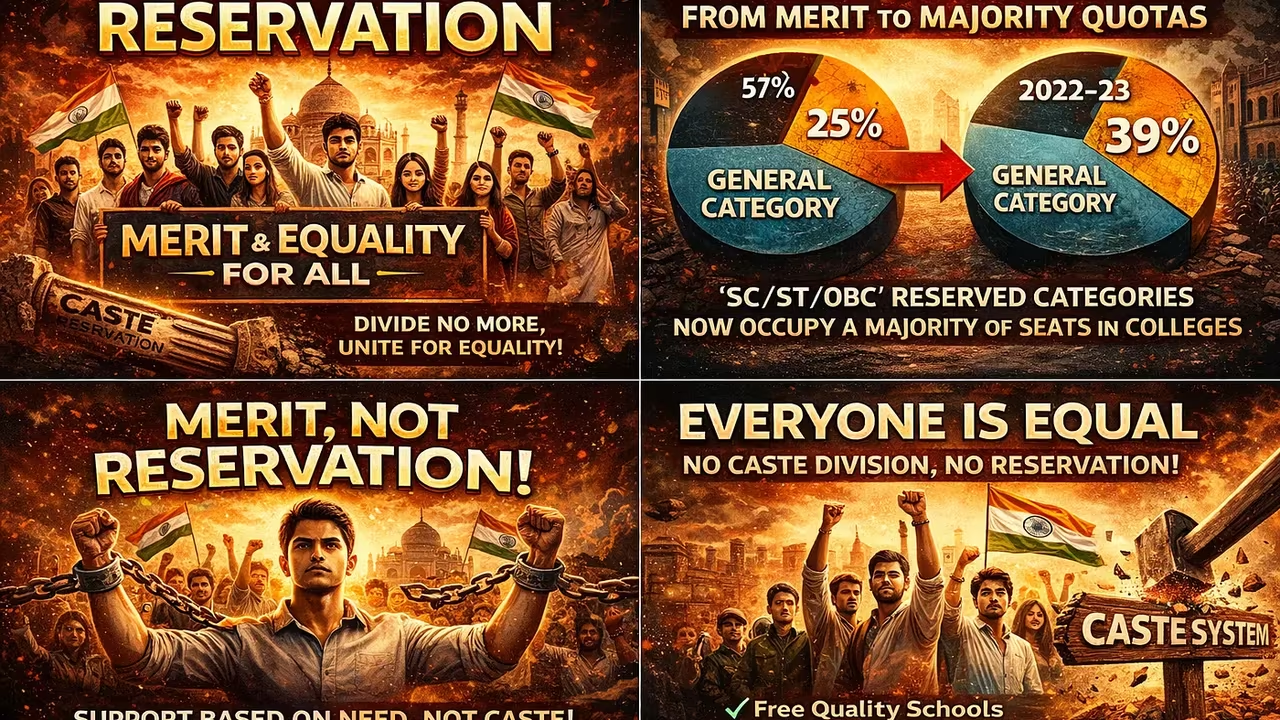
India’s Youth Demand Merit, Not Caste-Based Privilege
4 min read
·
1 hour ago
--
1
Listen
Share
It’s Time to End Reservation Laws in India — For a Fair, Equal and Merit-Driven Future
For decades, caste-based reservation has been one of the most debated policies in India. Originally introduced as a temporary measure to uplift historically disadvantaged communities, it has now become a permanent legal framework applied across education, jobs, and public life. But the environment in India today has changed dramatically, and data shows that reservation in its current form no longer reflects actual social realities — it creates division, reduces meritocracy, and harms general category students who receive no equivalent state support.
Data Paints a Clear Picture: The Playing Field Is Not Equal
Recent research based on the All-India Survey on Higher Education (AISHE) reveals a dramatic shift in India’s education landscape. A study by the Centre for Development Policy and Management (CDPM) at IIM Udaipur analyzed over 43 million students across 60,000+ institutions and found that combined enrolment of students in Scheduled Castes (SC), Scheduled Tribes (ST), and Other Backward Classes (OBC) rose from 43.1% in 2010–11 to 60.8% in 2022–23. In the same period, General Category students’ share fell from 57% to just around 39%, even after including Economically Weaker Section (EWS) seats. In 2023 alone, SC/ST/OBC enrolment exceeded general category enrolment by about 9.5 million students.
This major demographic shift challenges the assumption that general category students dominate educational opportunities. The reality is that reservation now influences the majority of seats, and general category students face intense competition for a shrinking number of open seats. This data legitimately raises serious questions about fairness in access to higher education.
Reservation’s Original Purpose Has Been Outpaced
Reservation was intended as a short-term affirmative action to help historically oppressed communities overcome structural disadvantages. Today’s reality, however, suggests that the original battle has largely been won, at least in terms of access to higher education. Opportunities for SC/ST/OBC students have expanded significantly, often beyond what was envisioned at the start of these policies.
In many developed countries like the United States, affirmative action policies have faced legal limits. For example, the US Supreme Court recently ruled against race-based preferences in college admissions, emphasizing equality under law and the importance of merit. This shows that global discourse on affirmative action is shifting toward equal treatment for all while addressing disadvantage through targeted support rather than group-based quotas.
The Harm of Permanent Caste Quotas
Instead of reducing inequality, reservation in its current form has:
- Created dependence on quotas rather than motivation to improve competitiveness.
- Reduced the number of seats available for general category students despite equal or higher academic performance.
- Institutionalized identity divisions into everyday life, weakening unity and national cohesion.
- Encouraged political exploitation of caste identities for vote bank politics.
Such outcomes go against the spirit of a modern, merit-driven society and contradict the fundamental right to equality before the law.
Smart Alternatives: Support the Needy, Not the Categories
Ending reservation laws does not mean abandoning support for disadvantaged groups. On the contrary, India must implement fair, need-based welfare mechanisms that help the truly underserved no matter where they come from:
1. Free and Universal Access to Quality Education
Create government-supported schools, open tuition centres, and scholarship programs that are accessible to every child, especially those from economically backward families.
2. Free Medical Insurance for All Economically Weak
Healthcare should not depend on caste. Universal health insurance for low-income households will help families survive disease and financial crisis without discrimination.
3. Income-Based Scholarships and Coaching
Rather than caste quotas, students should be eligible for financial aid, exam fee waivers, and competitive exam coaching based on family income, not ancestry.
4. Targeted Support for the Truly Disadvantaged
Ensure that any remaining affirmative actions focus strictly on socio-economic hardship, disability, rural deprivation, and other objective indicators of disadvantage.
This model ensures the help goes where it is needed most — without dividing citizens by caste or identity.
To the Youth of India: Demand Equality, Not Division
Indian youth must refuse to be manipulated by political parties that protect reservation as a vote-gaining strategy rather than a development policy. Across the political spectrum, reservation has become a tool to secure loyalty, not to empower the nation.
General category students are not unprivileged by choice — they earnestly seek fair opportunities just like every other Indian. Your future should not be obstructed by laws that favor identity over effort.
Final Call: One Law, One Standard, One Nation
In a democracy as diverse as India, true strength lies in unity. Equal opportunity for education and employment should be guaranteed to every citizen — no matter caste, creed, or community. Removing reservation laws from education and all sectors, while replacing them with targeted, need-based welfare, will build a system that empowers the poor and uplifts the nation.
Everyone is equal.
Opportunities should be equal.
Support should reach the needy — not the categories.
That is the India we must strive for.
by :- unkown