Iranian women footballers are seeking asylum after an anthem protest. Here’s what you should know.
Explain | 19.03.2026 15:11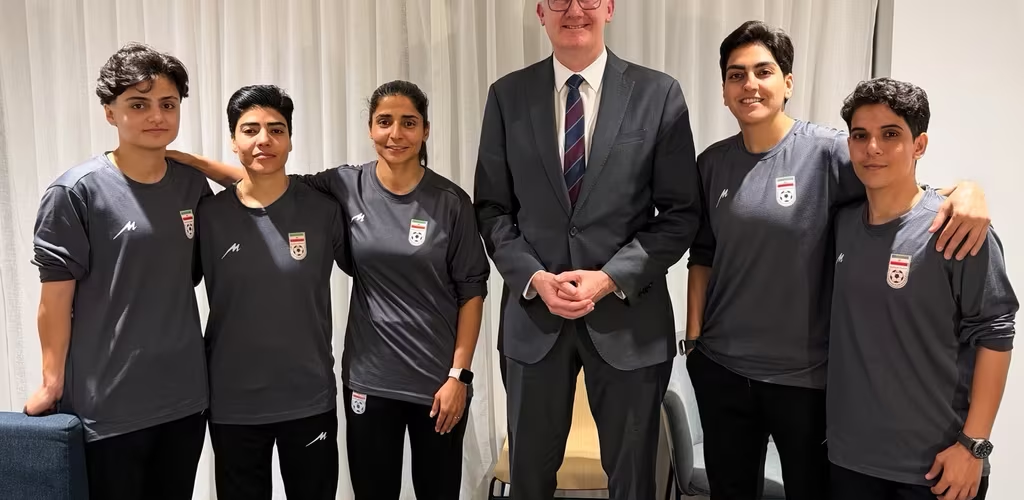
Several members of the Iranian women’s national football team sought asylum in Australia after refusing to sing the national anthem at the AFC Women’s Asian Cup. Their move highlights the ways in which sport, politics, and safety connect.
Sport and politics frequently collide on the global stage, despite the best efforts of those more conservative sports administrators and associations who believe sport should be “apolitical”. Case in point: earlier this month, some members of the Iranian women’s national football team sought asylum in Australia when they travelled Down Under to participate in the 2026 AFC Women’s Asian Cup. International tournaments can present opportunities for athletes fearing persecution at home, and the Iranian footballers weren’t the first sportswomen (or men) to grab this chance.
A country can grant asylum or, in simple English, protection, to people outside their own country who are seeking safety from persecution, serious harm, or for other compelling reasons. This includes not being sent back to danger, being allowed to stay in the country to which they are travelling, being treated humanely, and having a chance to rebuild their lives.
Refugees are protected under the 1951 Refugee Convention and its 1967 Protocol, which says a refugee should not be returned to a country in which they face serious threats to their life or freedom. The legal document states that for a person to qualify for asylum, they must prove that they are at risk of persecution because of factors such as their race, religion, nationality, political views, or belonging to a certain group.
Members of the Iranian women’s national football team made headlines when they refused to sing the national anthem before their first Women’s Asian Cup match against South Korea on 2 March. This was just a couple of days after the United States and Israel attacked Iran, starting a war that is ongoing and has spread to other countries in the Middle East. Iran’s Supreme Leader, Ayatollah Ali Khamenei, was killed in a strike on the first day of hostilities.
The players’ failure to sing the national anthem sparked backlash back home and was viewed as an act of defiance against the Iranian government. Iran state television presenter Mohammad Reza Shahbazi accused the players of “dishonour”, labelling them as “wartime traitors” and accusing them of a “lack of patriotism”.
Fifpro, the global organisation for professional footballers, asked Fifa and the Asian Football Confederation (AFC) to ensure the Iranian players were protected. Members of the Australian-Iranian community also asked the Home Affairs Minister, Tony Burke, to grant the players refuge.
Subsequently, six players and one support staff member decided to seek asylum Down Under and were granted fast-track visas through Australia’s humanitarian visa programme. However, five of the group later changed their minds and decided to return home, leaving only two players behind in Australia. They have already started training with a local football club, Brisbane Roar.
The Iranian team’s situation is not unique. There have been several previous cases of athletes seeking asylum in other countries, including Australia, as international sporting events have long provided opportunities for athletes to escape political pressure.
- The 1956 Summer Olympics were held in Melbourne, Australia, just as the Cold War was heating up. After the Soviet Union’s invasion of Hungary, 40 Hungarian athletes and officials refused to return home after the Games, instead seeking safety Down Under. Political tensions spilled over into contests on the field, or rather, in the pool, as well. During the men’s water polo semi-final between Hungary and the Soviet Union, the match turned violent as players kicked and punched each other.
- In 2006, 26 athletes and officials from several countries who participated in the Commonwealth Games in Melbourne, Australia, sought protection in the host country. (We wonder if there’s something in the water that makes Down Under a particularly attractive asylum destination?) The athletes seeking asylum included team members from Cameroon, Ghana, Nigeria, Sierra Leone, and Bangladesh who feared persecution back home. Among them were women who feared circumcision should they return to their home countries.
- A more recent case involves Krystsina Tsimanouskaya of Belarus, who competed at the 2021 Tokyo Olympics. She publicly disagreed with her coaches’ decision to replace her in the 100m and 200m athletics events. They then decided to send her back home, but she refused to return to Belarus, fearing for her safety. Tsimanouskaya ended up being offered asylum in Poland and later went on to represent Poland in the 2024 Olympic Games.
- Cameroonian weightlifter Cyrille Tchatchet II competed at the 2024 Commonwealth Games in Glasgow. He left his team base after deciding it wasn’t safe for him to return home, for unspecified reasons. Tchatchet then spent two months homeless on the streets of Brighton, England, before he connected with a charity, which gave him support and helped him to submit an asylum application
For athletes who come from oppressive societies, international sports tournaments can provide a window of opportunity to seek safety, assert their rights, and navigate political pressures at home. The Iranian women footballers weren’t the first sportspeople to turn this to their advantage and, given the current state of the world, they probably won’t be the last.